This whitepaper highlights why Azure makes sense for applications that rely on SQL Server or Windows Server, based on four themes: security, innovation, hybridity, and cost.
View: Benefits of using Windows Server and SQL Server on Azure
Free Tech Blog from LogicCloud IT
This whitepaper highlights why Azure makes sense for applications that rely on SQL Server or Windows Server, based on four themes: security, innovation, hybridity, and cost.
View: Benefits of using Windows Server and SQL Server on Azure

Artificial Intelligence (AI) is the catalyst for the fourth industrial revolution, the most significant technological advancement thus far. AI has the potential to solve incredible challenges for all of humanity, including climate change, education, design, customer experiences, governance, and food. That said, among the biggest concerns regarding AI is the potential for unexpected and unintended consequences in building and deploying AI products. According to Nate Yohannes, Principal Program Manager for Mixed Reality and AI Engineering at Microsoft, having appropriate representation at decision-making tables when building AI products is critical to help prevent these unfortunate scenarios. From his perspective, representation will go a long way toward preventing the unexpected consequences of AI products, and it will also guarantee that the products that are created will have the widest consumer base possible: everyone.
Listen to this podcast for an inspiring conversation about how to make the possible a reality by approaching AI with a new mindset that takes into consideration its full potential for improving the lives of everyone.
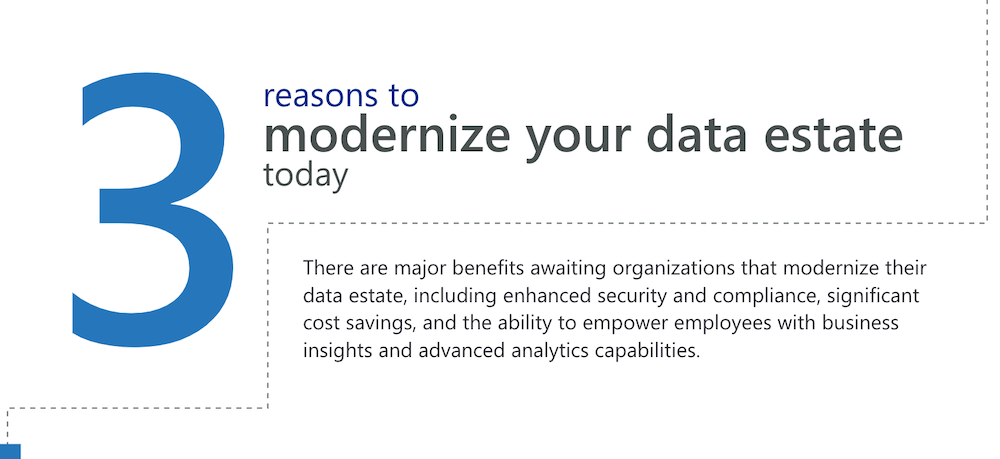
Organizations that modernize their data estate can reap major benefits, including enhanced security and compliance, significant cost savings, and the ability to empower employees via business
insights and advanced analytics capabilities. Organizations that don’t, on the other hand, risk putting themselves behind the curve by missing out on game-changing cost benefits, leaving their businesses open to potential vulnerabilities, and by not taking advantage of modern analytics capabilities.
Read this infographic to learn how businesses are taking advantage of the latest technologies by modernizing their datasets to create transformational benefits throughout their organizations, and discover how they’re doing so by leveraging Microsoft Azure.

Why run Windows Server on Azure? Ellen Kirby, senior manager of Technical Operations and senior enterprise architect at Bradley Arant Boult Cummings LLP, talks about the benefits of running the law firm’s Windows Servers on Azure and about leveraging Windows Admin Center for better management and automation.
When the pandemic ushered in a new reality of social distancing, Mercy Housing was able to continue supporting the residents and communities it serves while keeping everyone safe using Microsoft Teams. This customer story video outlines when COVID-19 created a tremendous need for a tool that can maintain personal connection, Teams has allowed the company to maintain reaching residents and serving its communities, growing the business while working remotely, all while supporting highly secure environments for remote work.
This infographic outlines how you can stay in touch with the hub for
teamwork in Office 365. With Microsoft Teams you can connect, collaborate, and come together securely by meeting with your peers and getting work done anywhere – even remotely.

Stay connected with Microsoft Teams while working from home with the help of the “Meet now” feature. In this video, you’ll learn how to use “Meet now,” which gives you the ability to turn a team chat conversation into an instant remote meeting.

Systems Imagination uses big data to discover new tiers of medical insights unobtainable through conventional means. In order to gain the distributed computing power it needed, the company adopted Microsoft SQL Server 2019 Big Data Clusters. Now, it delivers results based on petabytes of data to its customers within hours while simultaneously keeping operating costs low.

Data-sharing is an immense enabler of scientific advancements. When researchers choose to make their data publicly available, they are allowing their work to contribute far beyond the original findings. Making research data more accessible also fosters transparency and trust in their work, enables other researchers to reproduce and validate their findings, and ultimately, contributes to the pace of scientific discovery by allowing others to reuse and build on top of the data. Fortunately, cloud technology has made it easier than ever to share data across major research institutions. Empowered by tools that include Microsoft Azure, researchers are relying more and more on digital collaboration and open source software to drive scientific breakthroughs.
Watch this video to learn how researchers at Australian National University (ANU) are using Azure to build on each other’s findings and avoid a siloed approach to data that leads to slower research pipelines.
Take full advantage of your on-premises investments with Windows Server 2019. Learn how to extend your on-premises environments to the cloud with the Windows Server 2019 advanced hybrid capabilities. Additionally, learn how to add additional security layers and update your applications and infrastructure when you connect to the cloud.